
Unlike the Hammer Test, which tests the surface, the UPV Test penetrates into the concrete element. This allows the test to help assess:
- Concrete homogeneity and density
- The presence of internal cracks, voids, or honeycombing
- Estimated concrete compressive strength through correlation with pulse velocity
- Comparison of concrete quality between elements or areas
The UPV Test is often combined with the Hammer Test and concrete coring to produce a more reliable assessment of concrete quality.
Scope of Work & Work Stages
- Test Point & Measurement Method SelectionTest points and measurement methods are determined based on element conditions and available access.
- Surface PreparationThe concrete surface is cleaned and the transducer placement areas are prepared.
- Equipment CalibrationThe instrument is calibrated using a reference bar before testing.
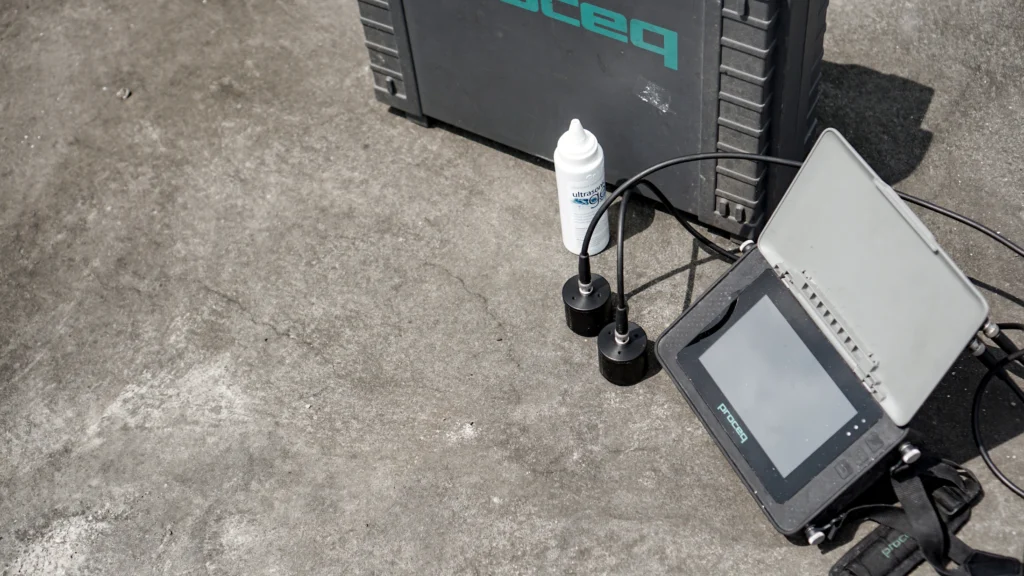
- TestingTransducers are placed on the concrete surface with coupling gel, then the ultrasonic pulse travel time is measured.
- Pulse Velocity CalculationPulse velocity is calculated from the distance between transducers and the travel time.
- Analysis & ReportingPulse velocity is assessed against concrete quality criteria and, if needed, correlated with the Hammer Test or coring to estimate compressive strength.
What You Get
- Ultrasonic pulse velocity data at each test point
- Assessment of concrete quality and homogeneity
- Indications of internal cracks, voids, or porous concrete areas
- Estimated actual concrete compressive strength
- Test point plan and photo documentation
- Conclusions and recommendations in the test report